
7 moments of truth
There are several moments when you, as a content consultant, can make a difference for your client. What kind of difference? Well, whether you're simply a top-notch content specialist, or whether you occasionally provide something extra. And you concretely fulfill the entrepreneurial role of Trusted Advisor, or whatever you want to call it.
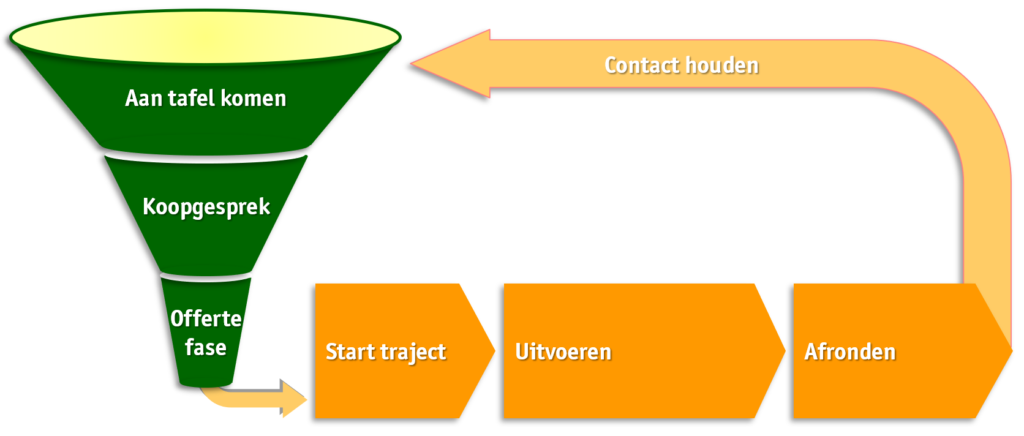
You can see these seven moments in the image below:
- Come to the table with people who can use your services
- Conduct purchase conversations to see if it's a good idea
- Providing a quote to confirm what you've agreed upon, if necessary. This is, of course, not relevant for everyone.
- The start of your assignment in which you do expectation management
- Activities during your assignment that make a difference
- The completion of your assignment, in which you consolidate the relationship, and…
- Keeping in touch with relationships, with the chance that you will meet people at the table again.

Sitting down with a client is a crucial step. You can only take on assignments if a client is willing to discuss their needs with you. How do you get a seat at the table?
- Make sure you and your colleagues recognize buying signals. Not just for yourselves, but especially for each other, so you can see opportunities together.
- It's also very helpful if you can clearly explain your favorite problem/buying signal to colleagues and contacts. This way, everyone can focus on identifying potential opportunities.
- Spend time regularly maintaining your network.
While the traditional salesperson is primarily concerned with convincing and removing objections, the partner does things a little differently. Here, he is primarily concerned with finding out
The question behind the question, and advising the client. A few points (more in the checklist below)
- Make sure your people prepare purchasing conversations well together
- Find out the question behind the question
- Let the customer think about “the solution on an A4 sheet”, don't be too quick to make a quote.
If you do the previous phase (the Purchase Conversation) well, this is a simple phase, because all the important issues such as scope, money, and decision-making have already been discussed. A good
quotation is a conversation report.
In the first hours and days of an assignment, you lay the foundation for the relationship. This is where you demonstrate that you want to act as a partner, not an executive. Consider:
- Managing expectations, both regarding the outcome of the assignment and the way of working together.
- Ask your client if they would like to hear your perspective as an outsider from time to time, even outside the scope of your direct assignment.
During the assignment, you can make a difference. Not only by delivering good work, but also by:
- Just drop by the client and other stakeholders a little more often.
- Identify and discuss problems, opportunities, and buying signals (especially those outside of direct work). Check if assistance is needed.
- Occasionally hold a strategic hour with the client
- Ensure that extra effort / additional work seen, appreciated and (in profitorganizations) is also paid.
You can also make a difference at the finishing stage. Consider:
- Evaluate in a personal conversation.
- Schedule a coffee meeting in a few months for follow-up and to find out how the effects of your project are going.
- Provide end of assignment advice.
- For a satisfied customer: ask for a recommendation.
Moment number 7: Keeping in touch
Networking is about sowing and reaping. If you only ask your people to network when new assignments or new colleagues are needed, you can expect a lot of resistance, and that's your own fault, not unjustified. That's why it's important to maintain your network even if you don't expect to get work from it immediately. Sowing and reaping, remember? What helps?
- Schedule a time in your calendar a few times a year to contact a number of former clients and other network contacts. For example, 3 times a Thursday afternoon with all the consultants.
- Schedule follow-up meetings in a timely manner, such as at the end of an assignment. If you do this consistently, you'll have regular networking appointments in your calendar.
Where the fruit hangs nice and low
Where would strengthening entrepreneurial behavior be most effective?

This article was written by Jan Willem van den Brink and Maarten van Os from DreamfactoryIt's based on a chapter from our book Client Wanted – Acquiring as part of your job.
If you wish to use it, we would greatly appreciate attribution.
Want to know more about this topic or how we can help your organization? Email or call us at 0348-741670.