
Asking follow-up questions with chunking
You steer the conversation by asking follow-up questions. Chunking helps with this. The word chunk means piece , part , or fragment . You ask follow-up questions about a specific part of a topic. The theory comes from NLP and linguistics.
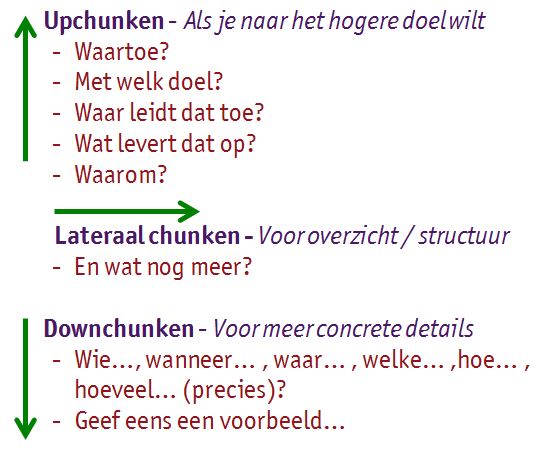
You can ask follow-up questions for larger or smaller “chunks” of information. With this, you can go in three directions:
- Towards a higher level of abstraction, towards the higher goal
- To another topic at the same level of abstraction
- To a lower level of abstraction, look up the details
Everyone has their own preferred style. For many professionals, that means looking up the details. Downchunking, in other words. Especially if they know a lot about a subject and are enthusiastic about it. That is fine when talking to a fellow hobbyist. When talking to a client, for example, it is also important to understand the ' why' (upchunking).

Suppose your conversation partner says: "With this program, I want our people to become more aware of their role model status."
If you want to reach the higher goal. Why is that important? What is behind this? You do that with questions like:
- And what is the purpose of that?
- And if people become more aware of their role model function, what would happen then?
- What does that yield?
If you want an alternative or the overview. If you want to know all the reasons and not just the first one mentioned.
- What else do you want to achieve with the program?
- And what else...
- And what else…
Tip: Between lateral questions, let the other person know you hear them by writing down the answer or humming.
If you want details. What exactly does the other person mean?
- You say that people need to become more aware of their role model function. Can you give an example?
- Which people in particular need to become more aware of their role model function?
- The concept of a role model is quite broad. What exactly do you mean by it in the context of your organization?
Depending on your goal, you choose which direction to take. What do you do and when?
With upchunking, you get to the question behind the question. This is, of course, very useful in many conversations. With upchunking questions, you get people thinking.
It is true that upchunking questions can sometimes feel a bit unsafe. Especially if you use the word 'why' . Why do you actually want a quality program? Of course, your intonation and non-verbal expression also play a role.
With a good upchunking question, you often see the other person's eyes go up. You make someone think. If someone says: "Good question…" , that was often an upchunking question.
Upchunking is also useful at the start of a meeting. Suppose you are going to have a meeting with seven people for an hour; it is nice to check at the start what we hope to achieve in this hour, before diving into the downchunk content.
Even when there are conflicts, upchunking helps to get the conversation back on track and to separate the main issues from the minor ones. So, in a conflict about a software system, first look up to the common goal: What we both want is a system that works well…
Upchunking naturally also has a disadvantage. And that is that it becomes less concrete. If you ask six upchunking questions in a row, you quickly end up with the meaning of existence or world peace.
Lateral chunking allows you to create an overview. This is useful, for example, if you first want to identify all the reasons someone has, instead of immediately zooming in on the first reason.
With lateral chunking, you create a list in no time, and we all do that occasionally for birthdays or a trip to the supermarket. Lateral chunking is very powerful after an upchunking question, because it gets people thinking.
Employer: Why are you applying to us?
Applicant: Because you have such a good reputation in the market and I want to be among the best.
Employer: Good to hear. And why else?
Lateral chunking is therefore often useful, because you create an overview. At the same time, it does require some self-control not to immediately jump into a topic the other person mentions.
It also feels unnatural at first to ask four times in a row and whatnot . For the narrator, that is much less strange, because after two times they understand that you are making a list of topics. It is good to write down the answers, however, so that you don't forget them and the other person sees that you take the answer seriously. Or by saying that you are finding out all the reasons first before going into depth.
Many people find downchunking the easiest. And downchunking is, of course, also very useful. Suppose there is an action item at the end of a meeting: Chantal is going to develop this idea further. Clear enough, right?
Well, no. Now it makes sense to downchunk before the meeting ends. When is Chantal going to do that? Who is she involving? What exactly will that elaboration look like? What will she report back on at the next meeting?
The intention is not to put Chantal on the spot, but rather to clarify expectations.
With downchunking, you get good answers to open-ended questions that start with where, who, when, how, and how much . If you add the word ' exactly ,' you go even deeper. Another good question is: Give an example.
Suppose someone says: "We want a fast and flexible system ." That is still very conceptual, and you would like to get more visuals and sound to go with it. You do that with downchunk questions like:
- When exactly do you consider a system flexible?
- What shows that a system is fast?
- Who exactly wants a fast and flexible system?
- Give an example of a fast and flexible system…
The risk of downchunking (too quickly) is that you start talking very enthusiastically about something that is not that important, or for which there turns out to be no support.

- Chunking is about becoming aware and making choices. Know your own preferred style.
- Also pay attention to your conversation partner's preferred style. If you are both naturally upchunkers, there is a good chance you will leave the conversation with a good feeling, but without a concrete agreement.
- When using the U-model to gain insight into the question behind the question. See chapter 5 Collecting purchasing arguments.
- First upchunk (What is changing in the organization?)
- Then laterally, gather all reasons (and what else, and what else?) and put in order of priority.
- Then downchunk, starting with the most important ones.
- Upon finding the Very Good Reason or business case in chapter 6 Zooming In and the Very Good Reason. You first go deep, and mainly ask how much and how often. Then you go up, upchunk, and ask kindly: So what? What makes that so important? Or: Why would we spend money on that?
- For (networking) conversations, first create an agenda (a list, so lateral chunking) of everything you want to discuss.
- When creating an IMI in chapter 4. With the Instruction, you downchunk: you ask very precisely what you want. With the Motivation, you are actually upchunking: the greater good.

This article was written by Jan Willem van den Brink and Maarten van Os from DreamfactoryIt's based on a chapter from our book Client Wanted – Acquiring as part of your job.
If you wish to use it, we would greatly appreciate attribution.
Want to know more about this topic or how we can help your organization? Email or call us at 0348-741670.