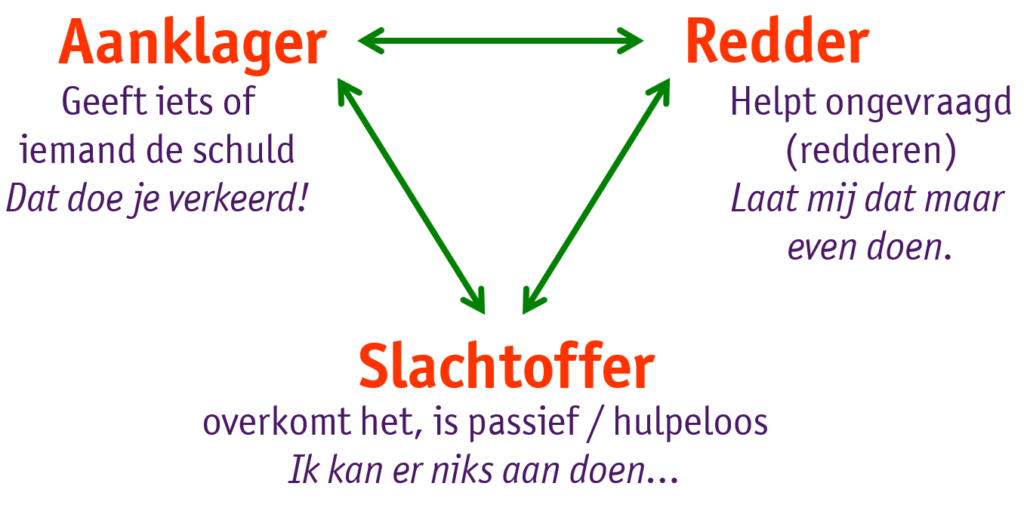
The drama triangle (Karpman) shows how people react to each other in predictable patterns during difficult situations. Victim behavior, for example, elicits Persecutor or Rescuer behavior. And vice versa.
Because the positions reinforce each other, the drama persists. Especially when emotions come into play. The art is to break the pattern.
If you recognize the positions, you can (together) break out of the pattern more easily.
What position do you often take? And which position of the other person annoys you the most?
Prosecutor
With a Prosecutor – set boundaries:
Thanks for your tip, and I'm not going to do it.
I didn't ask for your comment.
Redder
With a Rescuer – indicate what you do (don't) want:
I want to do this myself.
If I need your help, I will ask.
Victim
In case of a Victim – bounce the ball back:
Do you want to tell me something or ask me something?
What do you expect from me in this regard?
Do you recognize the accuser in yourself?
Lower your pitch and speak quietly.
Consider what is going well or what you appreciate in the other person.
Do you recognize the Savior in yourself?
Sit back and ask to what extent the other person wants help.
Remember: Shit happens
Do you recognize the victim in yourself?
Do something!
Stand up / sit up and breathe deeply.
Consider: if I could do something about it, what would it be?
This article was written by Jan Willem van den Brink and Maarten van Os from DreamfactoryIt's based on a chapter from our book Client Satisfied – From content expert to advisory partner.
If you wish to use it, we would greatly appreciate attribution.
Want to know more about this topic or how we can help your organization? Email or call us at 0348-741670.