
Build in triggers and checks to change?
There's a problem with taking entrepreneurial action. While important, it's rarely urgent. That's why we tend to postpone it.
In his book The Seven Habits, Stephen Covey described the Important versus Urgent matrix. This is also known as the Eisenhower Quadrant.
- Some activities are important, like maintaining your network. Some aren't, like filling out yet another online review.
- Some activities are urgent: someone is at your desk asking for your attention. Some aren't, like chatting with that new colleague. It's best to postpone that for a while.


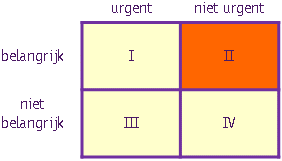
This gives you four quadrants, which Covey has numbered in a logical order.
Logically, you do I first and then II. And preferably as little as possible in III and even less in IV.
But in practice, things are often different.
Almost everyone tends to prioritize urgent or pressing actions over important ones. This isn't surprising, especially in the service industry. We want to please others and don't like to say no.
This can lead to you spending your entire day focused on things other people consider important, leaving you with little or no time for quadrant II. Sound familiar?
The action plan is finished, so we're done?
We find it remarkable that even organizations that are used to working with projects and project managers think that they can do without a project manager when it comes to increasing entrepreneurship.
Apparently, when it comes to entrepreneurship, things often have to happen spontaneously. Or, okay, after a fun training session and an inspiring speech.
Isn't it strange that people don't get moving the way you want?
You can probably sense it coming: many entrepreneurial activities fall into quadrant II. Networking, nurturing relationships, properly preparing for customer meetings, tracking current buying signals, creating a plan to surprise your customers, making an extra phone call to manage expectations, simply checking in with your stakeholders. All important, and you want to do them, but the daily grind often takes precedence.
If you truly want to do something with quadrant II activities, you'll have to manage them. Not because you're not motivated to do quadrant II activities, but because it's difficult to keep urgent tasks and people demanding your attention waiting. You work in the service industry for a reason.
Eisenhower offers an important tip in Quadrant II: Plan time for this. And that proves to be sensible, yet at the same time does not happen automatically. Neither the planning nor the actual execution. Time for Check.
By the way, the tip for quadrant IV is: Dump, stop doing it.
There's a persistent myth in management: if people are only intrinsically motivated, if they truly want to do something, they'll do it. Unfortunately, that's not true. A growing body of research shows that the influence of willpower and "understanding why it's good" isn't the decisive factor in behavioral change.
You often feel this yourself: just think of the list of good intentions at New Year's, which have largely evaporated for most people after a few months.
Professor Will Tiemeijer on willpower (from a radio interview)
It takes self-control to keep your impulses in check. The common assumption is that it's simply a matter of will. And if it doesn't work, you just have to try harder.
What the research shows is that it's not that simple. A large part of willpower is in the genes, just like intelligence. We rarely say to someone: "You just need to be a bit more intelligent." But if someone is less disciplined, we say something like: "Just try a little harder." That's strange, isn't it? Discipline is also partly formed in the first seven years of life. So: some people have more discipline than others. But that doesn't mean you can't do anything about it. You can't train pure willpower, but you can learn to manage it better.
You can develop habits that help you maintain discipline. For example, don't shop right before dinner, because when you're hungry, you'll buy much more.
You can learn to change your behavior by developing habits, in this case, doing grocery shopping after dinner. The key is to take small steps in developing useful habits. And then build on the acquired habit.
I struggle to get enough exercise. I've trained myself to walk to the station when it's not raining. By developing this habit, I no longer have to think about it, I don't have to constantly summon that willpower. And yet, I still get enough exercise. This is how you deal with your own lack of discipline, by forming good habits routinely.
Fortunately, you can get by without willpower. But you do have to put in some effort.
The key is to remind yourself of your resolution. To make it urgent. You can do this by incorporating certain triggers. If this, then that. In simple terms:
- If I go running 3 times this week, I will buy myself a good book this weekend.
- When I have a meeting with an employee, I ask what buying signals he has seen recently.
But involving other people also works well. If I want to lose weight, I might consider going for a run every Thursday evening at eight o'clock. If I arrange to do it with my neighbor, knowing that my neighbor will ring the doorbell at eight o'clock in their workout clothes increases the likelihood that I'll even go for a run in a light drizzle.
The neighbor acts as a kind of Friendly Conscience. A trigger in human form. In practice, such a Friendly Conscience proves to be a basic requirement for encouraging entrepreneurial behavior in a group.
Before we talk more about the Friendly Conscience and triggers in the next chapter, let's first consider a few pitfalls…
Pitfall 1:
Incorporating a trigger or check feels like pushing and we prefer not to do that here
For some managers, the word "check" sets off alarm bells. We don't want to micromanage or chase people. Our professionals are usually highly educated adults with good salaries. And they don't appreciate us looking over their shoulders.
We understand this sentiment, both from managers and consultants. Don't worry, we're not proposing micromanaging. What we do propose is starting a conversation about safeguarding and giving people input into how we approach it.
Pitfall 2:
Deposits should not be necessary
We already described it in 4.1: Building in checks to change? You cannot rely on willpower alone. And maturity also turns out not to be a decisive factor in behavioral change.
Your people are busy, and they are service-oriented. They often find it difficult to say no to their clients. Moreover, they sometimes have some stage fright, and then it is simply human nature that things don't happen automatically and that Quadrant II actions are postponed.
Pitfall 3:
I can also be enterprising myself without explicitly guaranteeing it, so it is not that difficult
Yep, you can do it, at least better than average. That's probably one of the main reasons they made you a manager/leader/senior/partner/managing consultant/boss. And that's why you're not representative of how your consultants handle this part of the job.
The good news is: they want it, and with a little attention, they will. What helps with that is a person playing the role of Friendly Conscience.
A list of sample triggers can be found in Chapter 4.6 of our book

This article was written by Maarten van Os and Jan Willem van den Brink from DreamfactoryIt's based on a chapter from our book Why don't they just do it? – Make sure your consultants and technicians find and keep clients happy.
If you wish to use it, we would greatly appreciate attribution.
Want to know more about this topic or how we can help your organization? Email or call us at 0348-741670.