
by: Miller Heiman
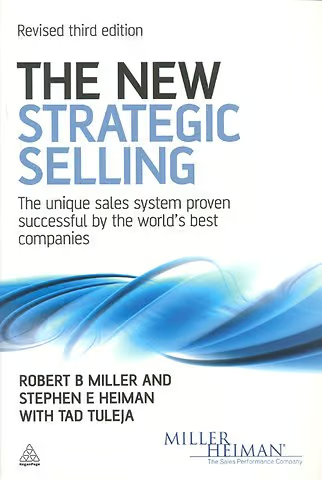
The new Strategic Selling
The Unique Sales System Proven Successful by the World's Best Companies
What do you want to sell, to whom, and why? Simple questions that not every professional salesperson or selling professional asks themselves before talking to their client.
Miller-Heiman is a renowned name in the sales world. They were one of the first to emphasize win-win solutions. They didn't focus on quick wins, tricks, or pushy tactics. Both the customer and the salesperson must benefit, or we won't do business.
That requires preparation. Think first, then act. That appeals to us. What can you do to ensure that the final sales conversations (covered in the book The New Conceptual Selling) go as well as possible for both parties?
They structure all of this preparation with their "blue sheet." A checklist with all the important information before you even start selling. This way, you bring structure to your sales process.

In the book you will find more information about:
- Buying influences: who are you actually selling to?
You can read more about this below - Red flags: what could hinder your sale and what do you do then?
Our theory of Bears on the Road or Naming What Is is, is partly fueled by this. - The ideal customer: which one should you focus your energy on?
- The sales funnel: where do you focus your energy when you want assignments?
There is also an audiobook available, in which the authors interview each other, making it an enjoyable listen.
The New Strategic Selling – Robert Miller, Stehpen Heimann and Tad Tuleja
More about Buying Influences
chapter 4: The four key buying influences
In this chapter, the authors examine the various factors that influence the purchase. They list four:
The economic buying influence
This is the person who ultimately decides on the purchase. Often, only one person is ultimately responsible for the budget, and this person is the one. This person often thinks in business case terms: what will this cost and what will it yield?
Naturally, you'll want to meet this person to discuss this. You'll also want to discuss how your service fits into their strategy and long-term goals.
The user Buying Influence
These people are the ones affected by the problem you're solving. They're generally happy to see you because they feel something isn't going as it should, and you can help them. It helps to ask thorough questions about their "pain," what they're experiencing, and what the impact is.
These people are also interesting to know, because they help you improve your solution and gain support.
The technical buying influence
These people are the people who can't say yes, but can say no.
Think of purchasing or financial managers. Or staff members working in your field. For a training agency, that might be the HR department.
These people aren't personally affected by the problem and would prefer it to be done their way, whether that means cheaper or with a method they prefer.
These people aren't always the seller's favorites, and you often have to deal with them. It often helps if they're persuaded by their own colleagues instead of you. So perhaps you can use User Buying Influence here, or The Coach, which we'll discuss below.
The coach
The coach is perhaps the most interesting category, precisely because they are sometimes forgotten or receive too little attention. Yet, they are also a very powerful support system.
A coach is someone within the client organization who is passionate about you, your organization, or your services. This could be someone you know from a previous project, or simply someone who's enthusiastic about your services. This could be someone with formal authority within the organization, but it doesn't have to be. A secretary who's a fan of yours is also very helpful.
Such a coach often has information for you and can connect you with people within the organization. They also ensure you get good press and are remembered for any issues you might be able to help with. They can also offer tips on dealing with technical buying influencers.
The book poses the question: think of the last five times you've sold something. How many of those times did you have a coach within the organization? Often, that's the case.
Conversely, if you don't have a coach in an organization and you are asked for an offer, it is questionable whether that is a good use of your time.
So those coaches are important. The tip is to give them the attention they deserve. These are typically people on your list of most important networking contacts.
The four "buying influences"
- Economic Buying Influence
- User Buying Influence
- Technical Buying Influence
- Coach

Would you like more information about this book, or to order it directly? We recommend Managementboek.nl.