
The Lucifer Story

It's great when you get assignments from your network. But it's crucial that people know what you're capable of. That's usually clear to you. But do others know it as well? And can they explain it to others?
The question your contacts then have (more or less consciously) is: How do I recognize people or situations that are interesting to you? In other words: when are you the right person in the right place? When should they hire you or your organization?
So make it as easy as possible for your contacts to identify potential assignments or clients. We do this with the match story. A short story you should be able to tell between the moment you strike a match and the moment your fingers are endangered by the approaching flame. And there's no need to hide a little fire or passion.

“If you can't explain it simply, you don't understand it well enough.”
- Albert Einstein
In the previous chapter we assumed buy signalsSo, the customer's problems and questions. Now we're looking at them from the other side: what are our "pet problems?" Because then you can find customers there.
When you tell your match story, the goal is for the listener to reflect on themselves and think about people they know who might be interested in talking to you.
You want to reach your network's network with your story. This is called second-degree networking. Think of colleagues, business associates, peers, and, of course, clients. So, you're not going to try to sell yourself to these people right away. You're hoping they can connect you with someone who is interested in your expertise.
In sales, the term "elevator pitch" is common. The idea is that you should be able to sell your services in the short time you're in the elevator with someone. Well, that never happens in our practice with the elevator, and we also don't like it when someone pushes their services.
We do think it's useful to explain to others in which situations you add value, so they can explore those situations with you. So, in your matchmaking story, you're not trying to sell something to your listener. You are asking if they'd like to explore situations where you add value. If they're interested, they'll certainly ask further.
Storytelling often uses a three-scene structure. In the first scene, something goes wrong. The bus carrying children is about to drive into a ravine—uh oh. In the second scene, the hero, 007 or Superman/Superman, springs into action, jumps, flies, shoots through the air with superpowers, and saves the children. In the third scene, all's well that ends well. The protagonists are enjoying a romantic glass of soda together.
The matchstick story also has three scenes, or images. Image 2 is your intervention. Perhaps your specialty isn't something with jumping and parachutes, but rather data management, delivering workshops, managing projects, consulting, designing, calculating, or something similar.
But you only do that when a customer has a problem. That's picture 1: something's about to go wrong, or something could be improved. Aha, a buy signal.
And ultimately, that benefits your customer. Something becomes better, faster, easier, cheaper, safer, etc., thanks to your intervention. The added value your customer ultimately pays for.
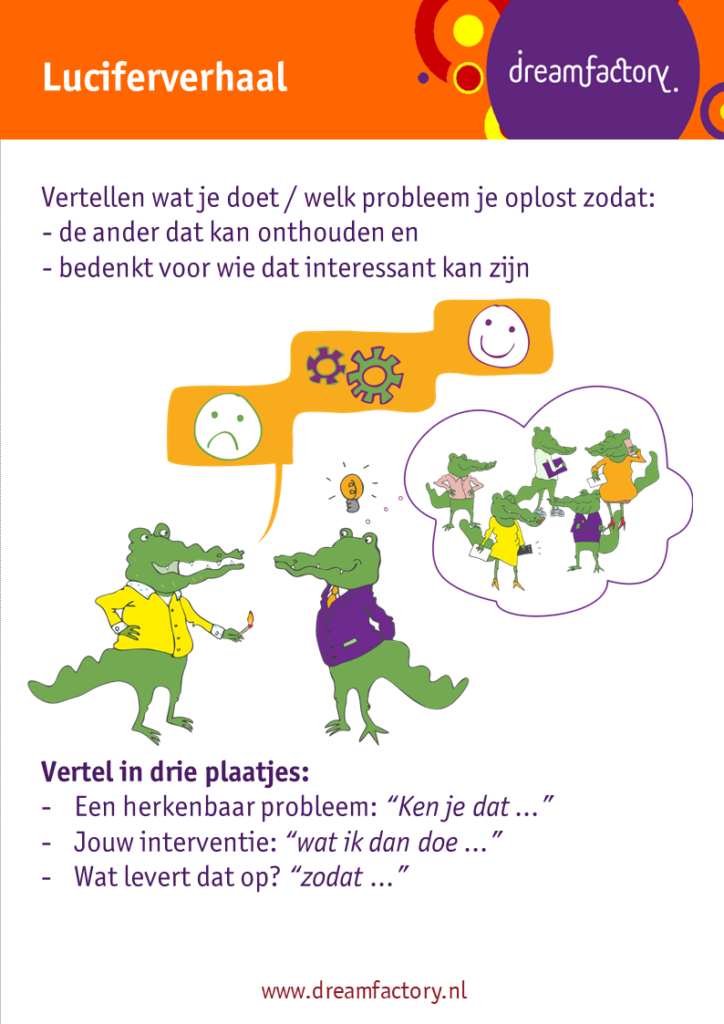
All three of these pictures are important. And which one is the most important? The answer becomes clear if we consider the purpose of the matchstick story.
The goal is to help the listener recognize situations where you add value. This way, the other person recognizes your image 1 in practice.
Talking about your scrum master, black belt, agile, certified gold expertise approach in Figure 2 is pointless if people don't know where it's useful. So that's not the most important thing.
And picture 3, isn't that important? Of course it is. You're also going to explain all the wonderful effects your intervention has. And picture 3 isn't more important than picture 1. Because people are better at recognizing problems than recognizing the potential benefits once that problem is solved. Problems inspire action. Long live the problem!
Let's take a closer look at the three pictures.
Your story begins with a recognizable problem. That image demands the most attention. Because people can often recognize problem situations, even if they don't know exactly what you're doing.
The question is: what recognizable problem do you solve for your customers? What is your domain? What do your customers complain about, or what are they afraid of that makes them contact you? In other words: what's your favorite buying signal?
The danger is that you're saying something like, "Actually, I can do everything..." But, of course, if you can do everything, you can't really do anything well. That's why a matchstick story often causes a "toothache."
Don't start image 1 with a long introduction of your name, position, organization, business unit, and title. That's usually boring, sorry. Instead, draw your listener right into the story. You can do this by starting with a sentence like:
- Do you know that…
- Research has shown that…
- I help/we help customers who…
- For many of our customers, …
- It was recently in the news that …
- An example is …
- You may have noticed that…
This picture is the least interesting of the three. Huh? But this is your field! You've spent years studying and working towards this. And wouldn't that be the most important picture?
That's because the goal of the match story is to get others to look for buying signals for you. And you'll find those in Figure 1. The goal isn't for them to be impressed by your expertise and credentials.
So keep this section short, no matter how captivating you find it. Beware of jargon or vague language, which can make the story difficult to understand.
Preferably not: Then we use the Deep Democracy model of the Lewis Method and the four steps to inclusive decision-making.
Rather: We'll work with committed civil servants to develop working methods that help people understand and appreciate each other. This will lead to a collaborative approach that works in practice.
Useful sentences to link the intervention in picture 2 to the recognizable problem in picture 1:
- What I do then…
- Our approach is then…
It's great that you carry out your interventions expertly and with pleasure. The question for outsiders is: What's the benefit?
What will be the result of your work? What will have changed in the organization when you're finished? Ideally, describe it in "er" terms, such as better, faster, cheaper, fewer, safer, higher, lower...
Describe the final effect. Preferably not: This optimizes the process. Better: This results in more enjoyment of the collaboration and fewer citizen complaints.
Useful words to link the result in picture 3 to the intervention in picture 2 are:
- So that …
- The effect of this is…
Do you remember the purpose of the matchstick story? It's to get the person you're telling it to to figure out where you can add value. So, a good question to ask after telling your matchstick story is:
pitfalls
- Making your match story too verbose and too long, so that the listener tunes out.
- Being too general or too woolly, so that the story doesn't stick.
- Using too much jargon, jargon, and abbreviations so that others don't understand the story properly and can't pass it on.
- Don't choose. Don't define your expertise too broadly, so others can't recognize specific situations in which they might recommend you.
- Using the match story to sell yourself, instead of helping others identify interesting situations for you.
- Putting your resume in your matchbook story. My name is Piet de Vries, and after studying Industrial Design at the University of Juinen, I worked for seven years at… Don't do it, start with a recognizable problem right away.
- Use vague words like effectiveness improvement, transparency in the broadest sense of the word or process optimization in your match story.
- Keep it short and simple. Structure your story around three or four keywords.
- When people ask you: What are you doing? Then start by explaining the types of problems you solve. This also works well when introducing yourself for a new project or client contact.
- Include passion or pride in your match story. That will stick. Show that you're enthusiastic about what you're telling. You can do this by using words like fun, with enthusiasm, what I like…, I like to work with…
- Practice with colleagues, friends, or family. Ask for feedback.
- If you want to share what you're proud of without bragging too much, you can use a quote from a satisfied customer:
- I'm proud that the customer said to me, “You guys are really quite good at that.”
- And of course you can make more than one match story.

This article was written by Jan Willem van den Brink and Maarten van Os from DreamfactoryIt's based on a chapter from our book Client Wanted – Acquiring as part of your job.
If you wish to use it, we would greatly appreciate attribution.
Want to know more about this topic or how we can help your organization? Email or call us at 0348-741670.