
Avoid barbed wire language in your conversations
Do you know of a conversation where someone skillfully creates an unsafe atmosphere? Where your hair stands on end and people react irritably to each other? Chances are that barbed wire language is involved.
Some language constructions almost automatically provoke resistance. It's helpful to recognize and avoid this kind of barbed language.
The word "why" has an aggressive connotation. People are implicitly called to account. Naturally, intonation also plays a major role.
- Why did the project run late?
- Why is that a problem?
Although the question itself is often indeed very interesting, a "why " question does not always come across as safe and pleasant. An alternative to "why" is "how did that happen" or " what causes that ." With this, you invite the other person to look at the causes together.
- Why has the project run late?
- What makes it a problem?

Another word that can evoke resistance on an unconscious level is "but." Yes, but … often means: no, because … And on an unconscious level, most conversation partners sense that perfectly.
- Your soup is tasty, but it is a bit salty often means: I don't like your soup because it's too salty.
- Yes, Jan is a suitable person, but he doesn't fit in with the team... can be translated as: Jan is not suitable because he does not fit in with the team.
- I'd like to go to your mother's this weekend, but... means: I'd rather not go.
People often unconsciously expect an attack after a "yes, but..." response. And an attack automatically triggers a defensive response.
What do you say then? A great alternative to yes, but … is very simple: yes, and …
- An excellent note. And I'd like you to elaborate on the third section.
As the English so aptly say: everything before the but is bullshit.
… is a variation on the “Yes, but …” It means something like: I absolutely do not respect what you are saying, and I am buttering you up a bit now so that you can’t catch me out on the fact that I am about to tell you something very nasty that is also personal.
Don't use it, okay?
Oh, how kind of you. Can I infer from this that you're not usually honest with me?
With certain sentence structures or remarks, you attack your conversation partner, belittle them, or do not take them seriously. Then your remark sounds as if you are quietly adding "comma-idiot" at the end.
Here are some examples with a friendlier alternative behind them:
Barbed wire language | Friendlier alternative |
Has anyone thought about…(, idiot)? | What's your opinion about…? |
You don't know what the turnover was last year (, idiot) do you? | What was the turnover last year? |
I bet you can't deliver that on time (, idiot)? | How fast can you deliver? |
You certainly didn't read the program (, idiot)? | To what extent have you read the program? |
You misunderstand (, idiot)! | I didn't explain that well. |
When exchanging ideas with clients, it may occasionally happen that you disagree with the client from the perspective of your profession. A (nearly) hypothetical example: a manager believes that all twenty of his employees need communication training, except for himself. You probably find it remarkable, and also rather stupid and shortsighted, to think that the blame lies solely with those twenty people. Inside, something arises like: you are seeing that wrong; you are part of the problem, friend.
However, it is not wise to say it like that. That is due to the accusation hidden in that sentence. For by hurting this manager's ego, you reduce the chance that you can help him. Therefore, it is better to use "I" in your response. For example: I have a different opinion. I think that a training session to strengthen communication and trust within a team would be significantly better if the team leader were present.
A "you" message ( "You are wrong" ) is often more aggressive than an "I" message ( "I have a different opinion "). There is less room for discussion regarding an "I" message, because that is simply your opinion, taste, or feeling. And by not speaking in terms of a "you" message, you give the other person more room to form a different opinion without losing face.
Sometimes you weaken what you're saying by using certain words. This makes the other person feel like you're beating around the bush. Think of words like:
- in fact
- as such
- actually
- possibly
- perhaps
- possibly
- a little
- in principle
- just
Another way to take yourself less seriously is to use the past tense or diminutives:
- I had a question. (Instead of: I have a question.)
- I was actually looking for Mr. Willems. (I am…)
- What was the name? (What is…)
- I thought the proposal was pretty good. (I think the proposal is this good.)
In fact, we thought, you can often just leave these kinds of words out more or less, without the sentence having to change substantively within the context, so that transparency as well as efficiency and effectiveness could possibly be increased.
Pardon me, of course we mean: it's better to leave these kinds of words out.
Of course, you don't want to offend your conversation partner with barbed language or "comma-dumb" questions in any conversation. Be especially careful during the following moments:
- In the U-model, you first discuss the client's problem and only then the solution. So you ask questions about that problem. And then there's a chance you'll (unconsciously) have an opinion about how the client has handled things so far.
- When identifying obstacles, be careful not to convey that the other person should have known or understood this long ago. You say it'll be ready in two months? That's impossible (you idiot).
- Even when it comes to negotiating or discussing the budget hurdle, it is important to be respectful of the other person's ego.
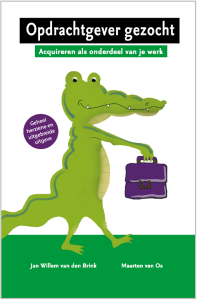
This article was written by Jan Willem van den Brink and Maarten van Os from DreamfactoryIt's based on a chapter from our book Client Wanted – Acquiring as part of your job.
If you wish to use it, we would greatly appreciate attribution.
Want to know more about this topic or how we can help your organization? Email or call us at 0348-741670.