
Training is fun.
But what does it yield?
One of our core values is achieving results (along with enjoyment and trust). We love results. We also enjoy providing training. How do you combine the two?
Kirkpatrick's model is useful in this regard. He made the distinction between behavior and effect in the late 1960s. And then he also ties training elements into it.
We made in the early years of Dreamfactory We often find that a training session went well, in our opinion. Participants were happy, and we were satisfied. Until a manager who hadn't attended the training himself remarked somewhat sourly that he hadn't noticed much of an effect yet. They hadn't sold as much as he'd hoped. Implicitly, the manager assumed that the training would be the end of it.
Then we came across Kirkpatrick's model. He splits:
What do people think of the training? Was it fun, did we have a good laugh, was the catering good, and was the trainer friendly?
Have people learned anything? And do they still remember it months or years later?
Do people change their behavior after the training? Do they apply that knowledge and skills in their daily work?
Is there an impact on the organization paying for the training? For example, will the figure in the monthly report ultimately go up or down?
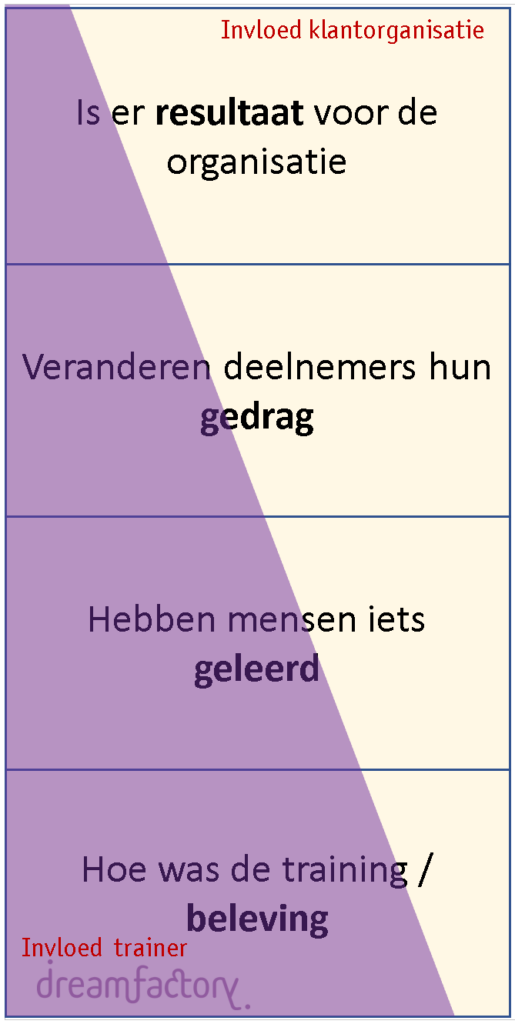
We've expanded Kirkpatrick's model with a slash. This indicates the division of labor between managers and trainers.
At the bottom, at the experience level, the training agency has a lot of influence. As we move up the model, the influence of the trainers decreases, while that of the managers increases.
This means we often train participants and coach their leaders. The question then becomes: what behavior can leaders demonstrate to ensure that the participants put the new behavior into practice? Which behavior is most likely to be effective?
In our programs, we use this image to brainstorm goals with leaders beforehand (see Part 2, Why). From there, we determine which specific behaviors would contribute to achieving those goals (Part 3, Choose).
We then determine what is learned and how we make it worthwhile for participants.
Then the question is: how can leaders ensure that participants implement the new behavior into their busy daily lives? (Part 4, Check). And what if that doesn't work right away? Then it's time to make adjustments (see Part 5, Coach).
That gives you the structure of what needs to be done (and the structure of this book): Why-Choose-Check and Coach. Before we dive into that, an interesting question is: what's actually holding your people back?
Belbin, beer and little results
One of us took a Belbin team roles training course when we were younger. What sticks with us is the memory of the hotel bar where we had a beer tasting with colleagues that evening. There was something about nine roles (or was it seven?), and I think there was a plant.
The evaluation of that training was fine, but what was learned had virtually evaporated after a few weeks; it resulted in absolutely no change in behavior. For the organization, there was ultimately some effect, namely higher employee satisfaction and more connection between colleagues. Important too. But it had nothing to do with those team roles.

This article was written by Maarten van Os and Jan Willem van den Brink from DreamfactoryIt's based on a chapter from our book Why don't they just do it? – Make sure your consultants and technicians find and keep clients happy.
If you wish to use it, we would greatly appreciate attribution.
Want to know more about this topic or how we can help your organization? Email or call us at 0348-741670.