
Tell me a story
It is nice to be able to talk about your own experience or that of your organization without boasting too much. Storytelling, or simply telling stories, is a great way to do this. If you hear a buying signal, you can share your experience regarding a similar situation.
Stories are everywhere in organizations. Stories about customers, about the market, about how things used to be in the company, about the IPO, you name it. And people regularly ask about them: 'How did your presentation go?', 'How was the meeting with that client?', 'How was your day?' During job interviews, stories are told about previous jobs. And during sales conversations, people talk about how things went with other clients. Stories stick. Often better than brochures or slick PowerPoint presentations. They are less intrusive than a sales presentation.

Why use stories?
Storytelling is therefore increasingly being consciously used as a communication tool. There are all kinds of stories, such as fairy tales and advertising stories. When it comes to finding assignments, you use stories based on personal experience. That is, stories that actually happened and in which you or your organization played a role. Why would you use stories in a commercial context? For a number of reasons:

Stories are not threatening. You don't tell the other person what to do; you tell them about a different situation. And what every human being does is relate that other situation to their own.
With stories, you can tell something about yourself without boasting too much. You could, of course, say: 'I am good at project management and I am reliable and creative,' but in our culture, that is not always appreciated. You can also tell the practical story of your latest assignment, which demonstrates this.
When people make a decision, they base it on feeling and reason. Of the two, feeling is by far the most important, behavioral scientists have established. In fact, decisions are often made on an emotional basis first, with the rational explanation found later. What people feel is influenced, among other things, by stories: stories that others tell them, and stories that they tell themselves.
Openness and connection in the conversation increase through a good story. You make yourself vulnerable when you talk about your own passion and emotion, and when you also talk about what didn't go so well. By doing so, you increase trust.
Stories are transferable. You can pass them on. And by doing so, you reach your contact's network.
Finally, stories are particularly useful when people doubt whether your service is the right one for them. You can use them to counter objections. (Client: 'Yes, but that obviously doesn't work at a small organization…' Professional: 'Six months ago, we got to help a company that was even smaller. And what we did back then…').
In short: storytelling is an interesting tool for persuading in a gentle way. You can use it, for example, with buying signals to show that you have experience with the subject, during networking conversations to share what you have been working on recently, or during sales conversations.
A beautiful quote from master storyteller Wibe Veenbaas: 'The story is already there.' It is about having the right story ready at the right moment and telling it. That is why it makes sense to collect your stories in a story library, so that you have them at hand when the situation calls for it. This can be done, for example, by collecting your stories in a document.
Different people are interested in different stories. That is why it makes sense to have something for everyone in your library.
To organize stories, you can distinguish between:
- stories about your organization;
- stories about your product or service;
- stories about you as a professional.
So how do you add material to your library? How do you recognize a good story? The source of a good story is emotion. If you think back to beautiful moments in your work, you will probably already come up with a number of great stories. Take a few of those moments when you were proud of your organization, or happy with the work you do. Make a list of such moments and then fill in the details for each event. Who was there? Which client? What was said? Where did things threaten to go wrong? What was the result? Why was that? What was the trigger? What exactly were you proud of?
The trick here is to seek out the detail. This is called downchunking (see section 7.3 Asking follow-up questions using chunking ). Take this story from a lawyer: 'I was at a client, a government agency, to draft a contract. We worked together wonderfully there and made good agreements. As a result, things just went smoothly.' This story may resonate with the narrator, because he still vividly pictures the situation, but for the listener, it doesn't really come to life.
The story gains more substance if it answers the question 'Can you give an example?' or 'What exactly did you do to make things run smoothly?' You might end up with something like: 'For example, we agreed to have an informal coffee with one of the contracting parties every Tuesday morning, and we would ask what they expected regarding the contract and where any ambiguities or concerns lay. That is how we discovered that the Purchasing department did not feel involved in our project, and was sometimes even being bypassed a little. We then invited them to a brainstorming session. That was quite nerve-wracking, because in fact we were already quite far along. I can still see them walking in; at first, they were sitting four people on the other side of the table, with their arms crossed. It took us half a day to break the ice back then, but we more than earned that back, because Purchasing actively supported the process from that point on.'
To ensure that your experience stories accurately reflect your work and that others can retell them, practicing helps. That might feel a bit strange at first. Everyone tells stories every day; do you suddenly have to start thinking about it now? Yes, we think so. You think about your CV, so why not about your 'verbal CV'?
The goal of storytelling is to clarify when someone can engage you, what you will do, and what the effect of that is for the client organization. When telling stories, you can use a script with three images, just like a director does. By describing your story in images, it is easier to distinguish the details. And details are often the key ingredients in a story. Another advantage is that it helps you bring structure to the story. An experience story has a standard structure in three images:
- Initial situation: an organization where something is going wrong.
- Middle situation: what have you done about it?
- Final situation: what was the result, the happy ending?
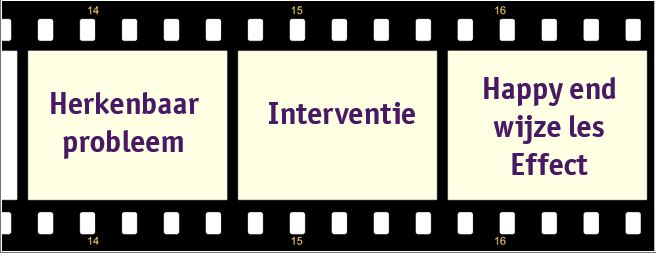
The first image outlines the initial situation. This image (unconsciously) provides the answer to the customer's question: 'When should I call you?'
Example: 'A while ago, I was approached by a manager at a financial institution. It was an insurance company. He picked me up in the central hall, surrounded by people in sharp suits. We took the elevator upstairs. The elevator door opened, and I felt like I was in a henhouse. One of those big open-plan offices where everyone was working all at once. Stacks of paper everywhere, memo notes on computer screens, people shouting at each other; it was quite hectic. The manager explained that the people in his department were struggling with prioritizing. And with saying no. And despite the fact that everyone was working hard, they were mainly busy putting out fires. The result was that business got lost, customers weren't called back, and people became less motivated.
The second picture is about the intervention. This picture answers the question: 'What do you do then?'
Example: 'What we proposed back then was to first organize something with the management team. Because our experience is that if something is going on on the shop floor, the same issue is also affecting the managers. That went well, and we were allowed to sit in on an MT meeting to observe how things went there. So we sat in and watched while the six MT members were at work. At first, of course, they found it a bit strange that we were there, but gradually they started doing what they always did: putting out fires.'
We only intervened after fifteen minutes. We asked everyone to indicate on a scale of 1 to 10 how effective they found their meeting. The average was just under 5. The managers agreed that they themselves did not set a clear priority for their department. They themselves said that they sought out side paths instead of following the main road. Then we could get to work.
We coached them as a team over five sessions, on the work floor. We did this during regular team meetings, so it didn't take much extra time. And along the way, you noticed that they intervened more and more often themselves when they – as they put it themselves – 'went down the side paths,' and that they needed us less and less to do so.
The nice thing was that one of the managers had hung a map of a maze in the meeting room. The moment they got lost, someone would always point to the map, and then they remembered: watch out, side paths!
The third picture answers the question: 'What was the result?'
Example: 'After six months, the managers received great feedback from the customer satisfaction survey. The employees felt that there was more calm in the department. The number of customer complaints had also decreased by over forty percent in a year. And the map of the maze is still hanging on the wall there.'
How do you ensure your stories stick?
What do good storytellers do? What makes their stories stick? In any case, they tell stories vividly, so that the listener can visualize the story. Furthermore, good stories also contain the ingredients of emotion, relatability, and embellishment.
Good stories contain emotion. Often, that is suspense. Something unexpected happens. Things threaten to go wrong, or something actually does go wrong. And that then needs to be resolved. Will it succeed? Suspense keeps listeners hanging on your every word. This has to do with the outcome, which they want to know, but of course also with the way you tell the story. With your voice usage, variations in volume and tempo, and the use of pauses. You also hold their attention by building bridges in your story. You do this with words like suddenly , all of a sudden , meanwhile , weeks later , but... what he didn't know then was...
Besides suspense, other emotions include, for example, being moved or pleasure. Naturally, the way of telling the story is important for these as well.
Good stories are relatable. The listener can project the elements of the story onto their own world. This means avoiding excessive jargon and instead focusing on generally recognizable situations. In the context of organizations, you might think of the distance between branch offices and headquarters, the distance between management and operations, nagging customers, complaining employees, different leadership styles, and projects running over schedule. This creates a sense of recognition.
By frills, we mean details that stick. Concrete images that people remember. It is the details that take the listener into the film of the story, so that he can 'visualize' it. Details add color to the story and make your story come alive.
A brief description of memorable facts, striking human behavior, unusual circumstances, the weather, the building where the story takes place, a description of a person. They make the story tangible. Like the map of the maze in the story above.

- Don't provide too much background and background in your story; just start at an appropriate moment.
- What we often do before going to a meeting is think about which stories we know that might be interesting for that conversation. So, stories with the same theme, or from the same industry, that demonstrate our experience and way of working. We don't tell all those stories, but if a question arises about our experience, we have a suitable example ready.
- It is fun to collect and share experience stories together with a number of colleagues. That way, you also get to know your colleagues and your organization better.
- You can also practice by, for example, telling stories to children. After all, details are the spice of life there too, and it is important that the story has a good structure.
- Don't ask yourself if you can tell stories; everyone can. We regularly start our training sessions with an exercise where a participant gets to share something about their experiences with the training topic. Time and again, participants are surprised by how many fun, touching, funny, and interesting stories can be heard.

This article was written by Jan Willem van den Brink and Maarten van Os from DreamfactoryIt's based on a chapter from our book Client Satisfied – From content expert to advisory partner.
If you wish to use it, we would greatly appreciate attribution.
Want to know more about this topic or how we can help your organization? Email or call us at 0348-741670.